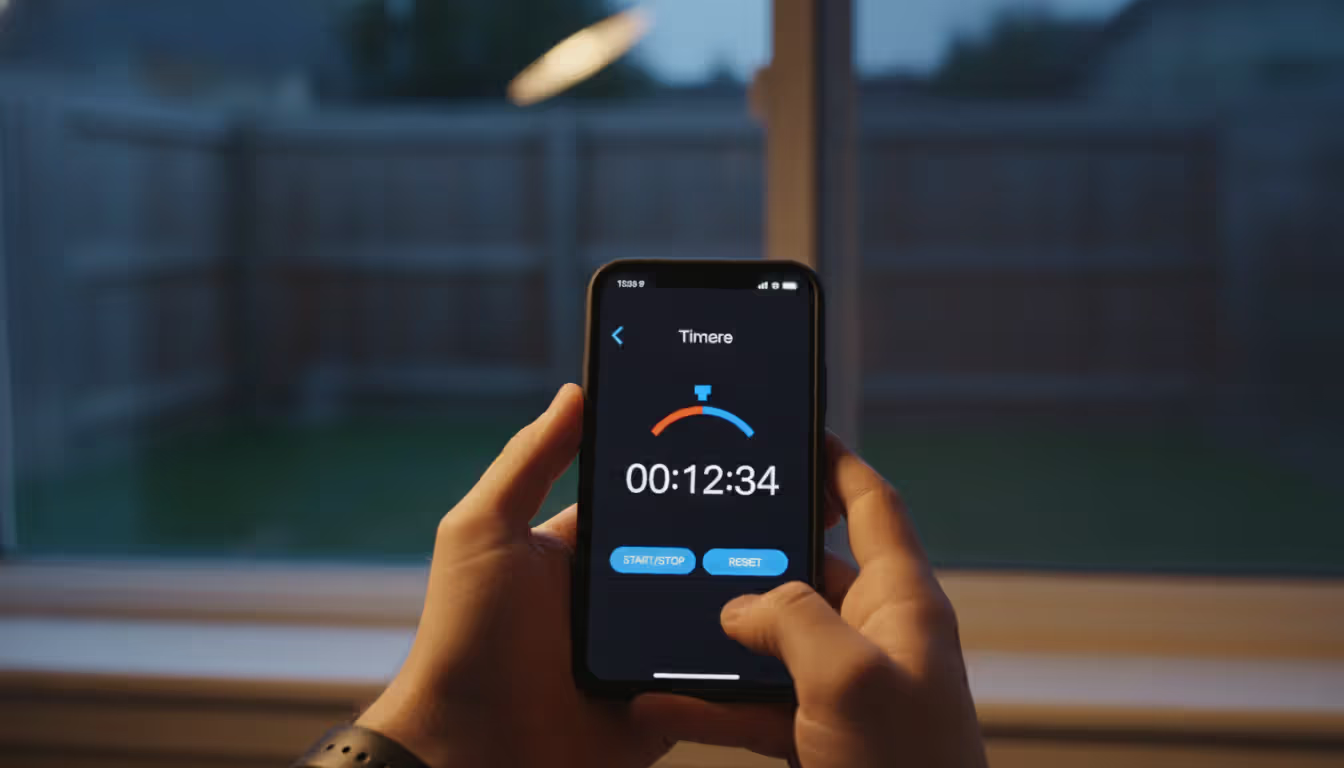
Your neighbor's German Shepherd starts up at 11 PM. Again. By midnight, you've counted three separate barking episodes, each lasting at least fifteen minutes. You've got work in the morning, but instead of sleeping, you're lying there wondering if this is finally enough to justify calling someone.
Here's the thing most people don't realize: you probably had grounds to file a complaint two weeks ago. Maybe longer.
Most dog owners handle their pets responsibly. But when someone either can't or won't stop their dog from barking constantly, you're not stuck just tolerating it. Laws exist specifically for this situation, and they're more detailed than you'd think. The real problem? Figuring out which agency to call, what evidence you actually need, and whether your three-minute iPhone video will hold up.
Let's break down exactly how this works—from the first time you grab your phone to record the noise through what happens if animal control basically ignores you.
Understanding Dog Barking Laws and Ordinances
There's no federal barking dog statute. The government in Washington isn't weighing in on your neighbor's Beagle. This is entirely a local issue, which creates a weird patchwork situation across the country.
Your city council or county board writes these rules. In Portland, they've decided that ten straight minutes of barking counts as a violation. Drive two hours south to Eugene, and they've drawn the line differently. Cross a county line, and the enforcement agency might change from animal control to the sheriff's department.
Most places bury their neighbor dog barking laws ordinance somewhere in Chapter 6 or 8 of the municipal code—usually tucked between "dangerous dog" definitions and leash requirements. You won't find a section titled "What To Do About Gary's Loud Husky." Instead, you'll see language like "No person owning or harboring any animal shall permit such animal to unreasonably disturb the peace."
Thanks. Super helpful.
Some cities get specific. Austin says you need either ten continuous minutes or thirty intermittent minutes. You can time it. Los Angeles goes with "disturbs the peace," which basically means the officer decides. Denver splits the difference: fifteen minutes straight, or thirty minutes within an hour if it keeps stopping and starting.
The anti-barking ordinance by city approach also determines who shows up when you complain. Big cities typically have dedicated animal control divisions—people who do nothing but handle loose dogs, bite reports, and noise complaints all day. Smaller towns? You might get a deputy who's also handling a theft report and a traffic accident. Rural counties sometimes contract with regional services that cover three or four counties with two officers.
Here's what actually matters when you're filing: does your ordinance use hard numbers or fuzzy language? Hard numbers ("ten minutes") mean you need to prove exactly that—your seven-minute recording won't cut it. Fuzzy standards ("unreasonable disturbance") give the enforcement officer wiggle room, which helps if you've got a borderline case but can hurt if they're looking for reasons to dismiss your complaint.
The dog noise ordinance local rules typically care about three things:
Duration: How long does each episode last? Two barks when the mailman walks by doesn't count. Forty-five minutes while the owner's at work probably does.
Timing: A dog barking at 2 PM gets way more leeway than one barking at 2 AM. Most ordinances define "quiet hours"—usually 10 PM to 6 or 7 AM—when even shorter durations trigger violations.
Frequency: Once isn't a pattern. Nightly for two weeks? That's a pattern.
Author: Marcus Redfield;
Source: jamboloudobermans.com
When Does Barking Become a Legal Nuisance
Dogs bark. Everyone gets that. They bark at squirrels, at the mail carrier, when a car door slams outside. If you called animal control every time a dog made noise, you'd be that person.
The barking dog nuisance legal definition centers on one question: is this preventing you from reasonably using your own home?
Can't sleep because of it? That's a problem. Can't work from home because of it? Problem. Can't open your windows without being blasted with noise? Also a problem. Heard one bark while getting the mail? Not a legal issue.
Most courts look at what they call the "reasonable person standard." Would a typical person find this disruptive? One neighbor being extremely noise-sensitive doesn't necessarily make barking a legal violation. Three neighbors complaining about the same dog? Now you're talking nuisance.
Let's get into specifics, because this is where people mess up their complaints:
Duration thresholds change everything. In Phoenix, the rule is ten continuous minutes within a thirty-minute window. So if a dog barks for nine minutes, stops for five, then barks another nine minutes, that's eighteen total minutes but might not technically violate the ordinance because neither individual episode hit ten. You need to know your city's exact standard.
Time of day isn't just important—it's often decisive. That same ten-minute episode at 2 PM on a Saturday might be considered acceptable noise in a residential area. At 2 AM on a Tuesday? Almost certainly a violation. Many ordinances double down on nighttime noise, either shortening the duration threshold or increasing penalties for quiet-hour violations.
Some examples of how cities define this differently:
Los Angeles doesn't give you minutes. Their ordinance prohibits barking that "disturbs the peace," with stricter application from 10 PM to 7 AM on weekdays (11 PM to 8 AM on weekends). An officer has to determine whether it's disturbing. This subjectivity cuts both ways—easier to prove if it's obviously obnoxious, harder if it's borderline.
Austin's more mathematical: ten straight minutes, or thirty intermittent minutes total. And they don't care what time it is—daytime violations count the same as nighttime.
Portland goes with ten continuous or thirty intermittent within a three-hour period. That three-hour window matters—if you've got barking at 8 AM, 1 PM, and 6 PM, those probably don't combine into one violation.
Frequency separates annoying from actionable. A single bad night when the owner left town and the dog freaked out? That's unfortunate, but it's probably not worth filing over. Same scenario every Tuesday and Thursday for six weeks? You've got a case.
Here's something most people don't consider: context can flip the whole analysis. A dog barking frantically at 3 AM might be alerting to a break-in, a medical emergency, or a fire. That's not a nuisance—that's the dog doing exactly what dogs evolved to do. On the flip side, a dog barking because its owner leaves it chained outside in 20-degree weather might get the owner cited for animal cruelty in addition to noise violations.
How to Report a Barking Dog Legally
You can't just call up and say "my neighbor's dog barks a lot." Well, you can, but nothing will happen. Filing dog barking noise complaint the right way means building a case before you ever contact authorities.
I've seen people call animal control after one bad weekend, provide zero documentation, then get frustrated when nothing happens. The system doesn't work that way. Think of this like insurance documentation after a car accident—you need evidence, and the more detailed, the better.
Documenting the Noise Problem
Start a log right now. Not next week when you "have time." Tonight, when the barking starts again.
Open a note on your phone or grab a notebook and create columns: Date, Start Time, End Time, Total Duration, Pattern (continuous or intermittent), and Notes. Every single time the dog barks long enough to bother you, record it.
Here's what a good entry looks like: March 15, 2024 | 11:43 PM - 12:14 AM | 31 minutes | Continuous with brief 1-2 minute pauses | Loud barking, could hear clearly through closed bedroom window
Not this: Tuesday night | late | forever | wouldn't stop
The first entry works as evidence. The second is useless.
Keep this log for at least two weeks before filing, longer if you can stand it. You're establishing a pattern. One night of documentation shows an incident. Fourteen nights shows a chronic problem.
Video evidence changes everything. Your smartphone already timestamps recordings—that metadata is gold when you're proving your case. Record from inside your home with windows closed to show that the noise penetrates your living space. Narrate if you want: "It's 11:30 PM on March 15th, I'm in my bedroom with the window closed, and you can hear the dog from three houses down."
Get multiple recordings across different days. Five recordings from five different nights over two weeks is vastly stronger than five recordings from the same night.
Audio-only recordings work too, especially if you're documenting middle-of-the-night disturbances when video would just show a dark screen. Some people use noise meter apps to measure decibel levels. These rarely matter for ordinance violations—most codes don't specify volume thresholds for barking, just duration—but they don't hurt your case.
Talk to other neighbors. Seriously. Knock on a few doors during daylight and ask, "Does that dog at [address] bother you too?" If multiple households are affected, get written statements. These don't need to be formal—an email saying "Yes, I also hear the dog barking excessively between 11 PM and midnight most nights" from two or three neighbors makes your complaint exponentially stronger.
Some jurisdictions literally won't investigate single-complainant reports. They require two or three affected households before they'll send someone out.
One thing to avoid: confronting the neighbor first if you've already tried talking and got nowhere. Some people suggest always attempting a friendly conversation before filing. That's fine for a first approach, but if you've already asked nicely and nothing changed, documenting another conversation doesn't help your case. It just gives the neighbor a heads-up that you're building documentation.
If you did try talking to them, note those conversations in your log: "March 3, 2024 - Spoke with owner, explained barking keeps us awake. He said he'd work on it." Then document that nothing changed.
Author: Marcus Redfield;
Source: jamboloudobermans.com
Finding Your Local Dog Noise Ordinance
You can't report something properly if you don't know what law applies. How to report barking dog legally starts with finding the actual ordinance text.
Go to your city's official website and search "municipal code" or "city ordinances." You're looking for the searchable code database—usually a somewhat clunky interface that looks like it was designed in 2003. Search terms like "barking," "dog noise," "animal noise," or "nuisance animal."
Can't find it online? Call your city's non-emergency line (not 911) and ask directly: "Which department handles barking dog complaints, and where can I find the relevant ordinance?" The dispatcher can route you to animal control, code enforcement, or whoever actually handles this.
When you find the ordinance, read the whole section. Don't skim. You need to know:
Exact duration thresholds (if specified)
Time-of-day restrictions
Whether complaints must be in writing
Whether you can file anonymously
What documentation they require
Who enforces it (animal control, police, code enforcement)
Screenshot or print the relevant sections. You'll reference these when filing and potentially need to cite specific ordinance numbers.
Some cities have moved to online complaint portals where you upload videos directly. Others still require paper forms submitted in person during business hours (usually somewhere inconvenient, open 9-3 on weekdays). A few have 24-hour hotlines. Know which system your city uses before you plan your filing approach.
Here's a practical example: Denver's ordinance is Section 8-18 of the Denver Revised Municipal Code. It requires barking to exceed fifteen continuous minutes or thirty intermittent minutes within a one-hour period. Enforcement comes from Denver Animal Protection. They accept online complaints through the city website. Knowing all of this before filing means your complaint goes to the right place with the right evidence meeting the right standard.
Compare that to a small town that might say "excessive dog noise prohibited" without specifics, routes complaints through the police department, and requires you to file a paper form in person at town hall between 9 AM and 4 PM on weekdays. Same problem, completely different process.
Once you've got the ordinance, the enforcement agency, and the filing procedure figured out, assemble your complaint package: - Completed forms (if required) - Your documentation log - Video/audio files (uploaded, linked, or on a USB drive depending on their system) - Written statements from other neighbors - Any photos of the dog's living situation if relevant
Submit everything according to their specified method. If you're filing in person, ask for a case number and the name of whoever's handling it. For electronic submissions, save confirmation emails and note the date filed.
Then comes the hard part: waiting.
Dog Noise Violation Penalties and Enforcement
Author: Marcus Redfield;
Source: jamboloudobermans.com
Understanding the dog barking ordinance enforcement process helps manage expectations. This isn't a fast-food drive-through where you order and get immediate service. It's bureaucracy.
After you file, here's the typical sequence:
An officer gets assigned your case—could be same-day in a well-staffed urban animal control department, could be two weeks later in an understaffed county agency. They review your documentation and contact information.
The dog owner receives first contact, usually a courtesy call or a letter that says something like: "We received a noise complaint regarding your dog. Please be aware that City Ordinance 8-18 prohibits excessive barking. Take steps to address this issue to avoid further action."
No fine yet. No citation. Just a heads-up.
This warning approach frustrates people who've been losing sleep for months, but it's standard. Enforcement agencies view it as educational—maybe the owner genuinely didn't know their dog barks all day while they're at work.
Some ordinances require the officer to independently verify the violation. They might drive by the property during times you've reported barking or even sit in an unmarked car for thirty minutes documenting the noise themselves. Other jurisdictions, especially understaffed ones, rely entirely on your submitted evidence without independent verification.
The warning period typically lasts 7-14 days. If the barking continues after that window, enforcement escalates.
Now we're talking citations and dog noise violation penalty fine amounts. These vary wildly:
City
Barking Duration Threshold
Time Restrictions
First Violation Fine
Repeat Violation Fine
Enforcement Agency
Austin, TX
10 min continuous / 30 min intermittent
Same standard 24/7
Warning only
$500
Austin Animal Services
Denver, CO
15 min continuous / 30 min in 1 hour
Stricter enforcement 10 PM-7 AM
$150
$500-$999
Denver Animal Protection
Los Angeles, CA
"Disturbs the peace" (subjective)
Quiet hours 10 PM-7 AM weekdays, 11 PM-8 AM weekends
$250
$500-$1,000
LA Animal Care & Control
Portland, OR
10 min continuous / 30 min within 3 hours
No time-based distinctions
$100-$250
$250-$500
Multnomah County Animal Services
Phoenix, AZ
10 min continuous in 30-min period
Stricter standards 10 PM-6 AM
$150
$300-$2,500
Phoenix Animal Care & Control
First violations in many cities range from $50 to $250, assuming they fine at all and don't just issue another warning. Repeat violations—usually defined as a second offense within six months to a year—jump significantly, sometimes to $500 or $1,000.
Phoenix is the outlier on that table. Their repeat violation penalties can hit $2,500, which makes owners pay attention fast.
Here's something important: in most jurisdictions, the officer doesn't need to personally witness the violation to issue a citation. Your documented evidence, especially with video timestamps and corroborating neighbors, can support a citation even if the officer never heard the dog bark. This matters because many dogs quiet down when strangers approach.
Owners can contest citations. They request a hearing with an administrative law judge or go to municipal court, depending on local procedures. The hearing date might be 4-8 weeks out. During this time, the barking often continues without additional penalties until the case resolves.
If you end up testifying at a hearing, you'll need your documentation. Bring your log, your videos, everything. The owner might claim their dog barely barks, or that you're exaggerating, or that other dogs in the area make noise too. Your timestamped evidence counters those defenses.
Chronic violators who rack up multiple citations face escalating consequences beyond fines. Some cities can declare a dog a "public nuisance," leading to: - Mandatory professional training (at owner's expense) - Restrictions on outdoor time - Required soundproofing or indoor housing - In extreme cases, removal of the animal
That last option—removal—rarely happens unless we're talking about someone who's accumulated five or six violations over a year and shown zero effort to fix the problem. Courts don't want to remove pets if there's any other option.
Realistically, how long does this process take? In well-resourced cities with responsive animal control, you might see action within 2-4 weeks of filing. In understaffed agencies, it can stretch to 2-3 months. Budget cuts have hammered animal control departments nationwide—some operate with half the officers they had ten years ago while handling more complaints.
The biggest mistake people make is expecting immediate results and giving up after one complaint. Building a solid case takes time and consistent documentation. I've seen residents submit one complaint, see no instant change, and conclude the system doesn't work—but enforcement is a process, not an event. The cases that succeed are those where complainants provide detailed, ongoing documentation and follow up appropriately
— Jennifer Hartman
Jennifer's point is critical. If you file once with minimal documentation, nothing happens, and you give up, you've confirmed the system doesn't work for lazy complaints. If you file with strong evidence, follow up when needed, and stay organized, your chances of resolution increase dramatically.
Legal Remedies If Your Complaint Fails
Sometimes animal control doesn't respond. Sometimes they respond but the owner ignores the citations. Sometimes the agency is so overwhelmed that your complaint sits in a queue forever while you keep losing sleep.
When dog noise complaint failure to act becomes obvious—usually after 60-90 days of municipal process going nowhere—legal remedies for neighbor barking dog extend beyond waiting for an understaffed agency to help you.
Community mediation costs almost nothing and works better than you'd expect. Many counties fund neighbor dispute mediation programs. A neutral mediator sits down with you and the dog owner to work out a voluntary agreement.
This sounds touchy-feely and useless, but here's why it often works: the dog owner might be ignoring warnings from faceless bureaucrats but won't ignore sitting across a table from you while you explain that their dog barking at 2 AM is affecting your job performance and family life. Mediation humanizes the conflict.
The mediator helps develop concrete solutions. Maybe the dog stays indoors from 10 PM to 6 AM. Maybe the owner hires a trainer. Maybe they agree to install one of those ultrasonic bark deterrents. You get actual resolution instead of ongoing citation battles.
Mediation works best when the owner isn't malicious—they're just oblivious or overwhelmed. It fails when you're dealing with someone who genuinely doesn't care or is actively hostile. You'll know which scenario you're in based on previous interactions.
Small claims court is your next option. You can sue the dog owner for nuisance without hiring an attorney. Filing fees typically run $30-$100, and the limit on claims varies by state—usually between $5,000 and $10,000.
What damages can you claim? - Decreased property value (harder to prove without an appraisal) - Medical expenses if you've got documented stress-related health issues - Costs you incurred mitigating the problem (soundproofing, white noise machines) - Potentially lost wages if the sleep disruption affected your work
You don't need a lawyer for small claims. The whole point is self-representation. Your documentation log, recordings, and evidence of filed complaints become your trial exhibits.
Here's a secret: sometimes just filing the lawsuit fixes the problem. When your neighbor gets served with legal papers, it often triggers the "oh, they're serious" realization that warnings and citations didn't. You might reach a settlement before you ever step into a courtroom.
If you do go to trial, small claims judges have heard hundreds of neighbor disputes. They get it. Your video evidence and documentation log carry significant weight. The dog owner saying "my dog barely barks" doesn't hold up against fourteen timestamped recordings.
Civil nuisance lawsuits in regular court (not small claims) involve bigger stakes, larger potential damages, and usually require hiring an attorney. You're looking at several thousand dollars in legal fees, but you can seek injunctive relief—a court order that forces the owner to actually stop the nuisance.
Injunctive relief is powerful. A judge might order: - Dog must be kept indoors between 10 PM and 6 AM - Owner must complete professional training with a certified behaviorist - Installation of soundproofing in the owner's home - In extreme cases, removal of the dog from the property
Violating a court order means contempt charges. That's a much bigger hammer than a $250 citation. Contempt can mean jail time.
Getting to an injunction requires proving that: 1. The barking constitutes a nuisance under your state's common law 2. You've suffered actual harm 3. The harm will continue without court intervention 4. The balance of hardships favors you (your need for sleep outweighs the owner's desire to keep their dog outside at night)
This is where attorney representation becomes necessary. You're dealing with rules of evidence, motion practice, and potentially depositions. The legal fees might run $3,000-$7,000 depending on complexity and how far the case goes.
Restraining orders exist in some jurisdictions for extreme harassment situations. If the owner is deliberately allowing or encouraging the dog to bark at you specifically as part of a broader pattern of harassment, you might qualify. This is rare—most barking situations involve negligence or indifference, not intentional harassment. But if you've got evidence the owner sicced the dog on you or positioned it to deliberately disturb you, it's an option worth researching.
Before pursuing legal action, run the math. If you're facing $5,000 in attorney fees to sue someone who owns a house worth less than they owe on it, collecting a judgment might be impossible even if you win. If you could move for less than the legal costs, or install effective soundproofing for less, those practical solutions might beat a legal victory.
That said, sometimes it's the principle. If you're planning to stay in your home for years and the noise is genuinely making you miserable, the legal route might be worth it even at significant cost.
Most neighbor dispute attorneys offer free consultations. Use them. Explain your situation, bring your documentation, and get a realistic assessment of your options and likely costs. Some lawyers will send a demand letter for $300-$500 that resolves the situation without filing suit. That's often the sweet spot—credible legal threat at minimal cost.
Author: Marcus Redfield;
Source: jamboloudobermans.com
Frequently Asked Questions About Dog Noise Complaints
Can I file an anonymous dog noise complaint?
Depends entirely on where you live. Some cities accept anonymous complaints but give them lower priority—an officer might drive by but won't do much beyond that without a complainant willing to go on record. Other jurisdictions require your contact information and may even require you to testify at a hearing if the owner contests the citation. A few places let you file anonymously but ask for contact info if you want updates on the case. Check your local ordinance or call the enforcement agency to ask about their anonymous complaint policy. Honestly? Providing your identity usually gets faster, more thorough investigation. Officers take signed complaints more seriously than anonymous tips.
How long does a dog have to bark to violate noise ordinances?
No universal answer here—it's all local. Austin says ten minutes straight or thirty intermittent minutes. Denver wants fifteen continuous or thirty within one hour. Los Angeles doesn't specify exact duration, just "disturbs the peace." Phoenix requires ten continuous minutes within a thirty-minute window. Your neighbor three states over might have completely different thresholds. Nighttime violations often use shorter durations than daytime—five minutes at 2 AM might violate an ordinance that requires fifteen minutes at 2 PM. Look up your specific city ordinance before assuming you know the standard. The variation between neighboring cities is wild.
What evidence do I need to file a complaint?
Bare minimum: a detailed log showing dates, times, and durations over at least a week or two. Better: video or audio recordings with clear timestamps showing the pattern across multiple days. Best: all of that plus written statements from other affected neighbors. Some cities specifically require certain evidence formats or even notarized statements. Check local requirements before filing. Here's what makes or breaks complaints—one recording from one night shows an incident, but recordings from ten different nights over three weeks show a chronic problem. That pattern documentation is what triggers enforcement. Quality matters too: a clear 15-minute video recorded from inside your closed bedroom showing you can't sleep is way better than five blurry 30-second clips.
Can I be sued for filing a dog barking complaint?
Filing truthful complaints about genuine disturbances is legally protected activity. You can't be successfully sued for reporting actual violations. However—and this matters—if you file false complaints, exaggerate wildly, or file repeatedly with no legitimate basis just to harass a neighbor, you could potentially face a defamation or harassment lawsuit. Stick to honest documentation. If your recording shows eight minutes and the ordinance requires ten, don't claim it was twenty minutes. If the barking only happens twice a week, don't claim it's nightly. Truthful reporting based on real problems protects you legally even when the neighbor gets mad about your complaint. Lying or malicious false reports can get you in trouble.
What if animal control doesn't respond to my complaint?
First, confirm you filed correctly with the right agency—sometimes complaints disappear because they went to the wrong department. If you've verified proper filing but heard nothing within 2-3 weeks, call the agency directly and reference your case number. Ask for status. If they blow you off, request to speak with a supervisor. Document every contact attempt—dates, times, who you spoke with. Still nothing? Escalate by contacting your city council member or county supervisor. Their offices can often light fires under unresponsive agencies. You can also file a complaint with whatever body oversees animal control in your area. And if municipal enforcement has completely failed, you're not stuck—pursue civil remedies independently through mediation or court action.
Do I need a lawyer to take legal action against a barking dog?
For small claims court? No. That system is specifically designed for people representing themselves, and hiring an attorney often isn't even allowed. For a civil nuisance lawsuit in regular court seeking an injunction or substantial damages? An attorney is highly recommended even if not legally required. Most neighbor dispute lawyers offer free initial consultations—take advantage of these. Bring your documentation and get a realistic assessment of whether your case justifies the expense. Sometimes an attorney can solve everything with one demand letter for $300-500 without filing suit. If municipal enforcement has completely failed and you've got strong documentation spanning months, that demand letter might be the most cost-effective solution. Consider what you're trying to recover and your comfort with legal procedures when deciding. A $10,000 lawsuit over a problem that's been ongoing for years? Probably worth hiring help. A $2,000 small claims case? You can likely handle it yourself.
Filing a complaint about a neighbor's barking dog isn't about being petty or getting revenge. It's about using the legal tools your community created specifically for this situation to restore reasonable peace to your home.
The complaints that succeed share common elements: detailed documentation spanning multiple incidents, video or audio evidence with timestamps, understanding of local standards, and patience with the enforcement timeline. Rushing in with minimal evidence rarely produces results.
Most situations resolve through municipal enforcement when complainants do the legwork—maintaining logs, recording evidence, and following proper procedures. Enforcement agencies respond to organized, well-documented complaints. They ignore vague "the dog barks a lot" reports.
When the municipal route fails—either because the agency doesn't respond or the owner ignores citations—you've got options. Mediation works surprisingly well for many situations. Small claims court provides an affordable self-help option. Full civil lawsuits with injunctive relief cost more but deliver stronger remedies.
The goal isn't punishing anyone. It's getting sleep. It's being able to work from home without constant disruption. It's restoring the quiet enjoyment of your property that you're legally entitled to.
Start documenting tonight. Look up your local ordinance tomorrow. File when you've got solid evidence. Follow up when needed. Most barking situations resolve once owners understand the seriousness and take corrective action—but they need to understand you're serious, and nothing communicates that like proper documentation and following the process through.
When your dog bites someone inside your home or on your property, you face potential legal liability, insurance complications, and serious consequences. Understanding homeowner liability laws, insurance coverage, and your responsibilities can mean the difference between a manageable situation and financial devastation
Police K9 attacks can cause severe injuries and lasting trauma. Understand when you can sue for excessive force, how government liability works, what compensation you may recover, and the critical steps to protect your rights after a police dog bite incident
When your dog attacks another dog, euthanasia is not automatic. The outcome depends on injury severity, bite history, state laws, and circumstances. Understanding the dangerous dog declaration process, your rights during hearings, and legal consequences helps you navigate this crisis effectively
A severe dog attack requires immediate medical attention and legal action. Learn critical steps to take after being mauled by a dog, including emergency care priorities, reporting procedures, documentation methods, victim legal rights, and available compensation for injuries and trauma
The content on this website is provided for general informational and educational purposes only. It is intended to explain concepts related to animal law, pet ownership rights, service animals, dog bite liability, and animal welfare legislation in the United States.
All information on this website, including articles, guides, and examples, is presented for general educational purposes. Legal outcomes may vary depending on jurisdiction, state laws, and individual circumstances.
This website does not provide legal advice, and the information presented should not be used as a substitute for consultation with qualified attorneys or animal law professionals.
The website and its authors are not responsible for any errors or omissions, or for any outcomes resulting from decisions made based on the information provided on this website.