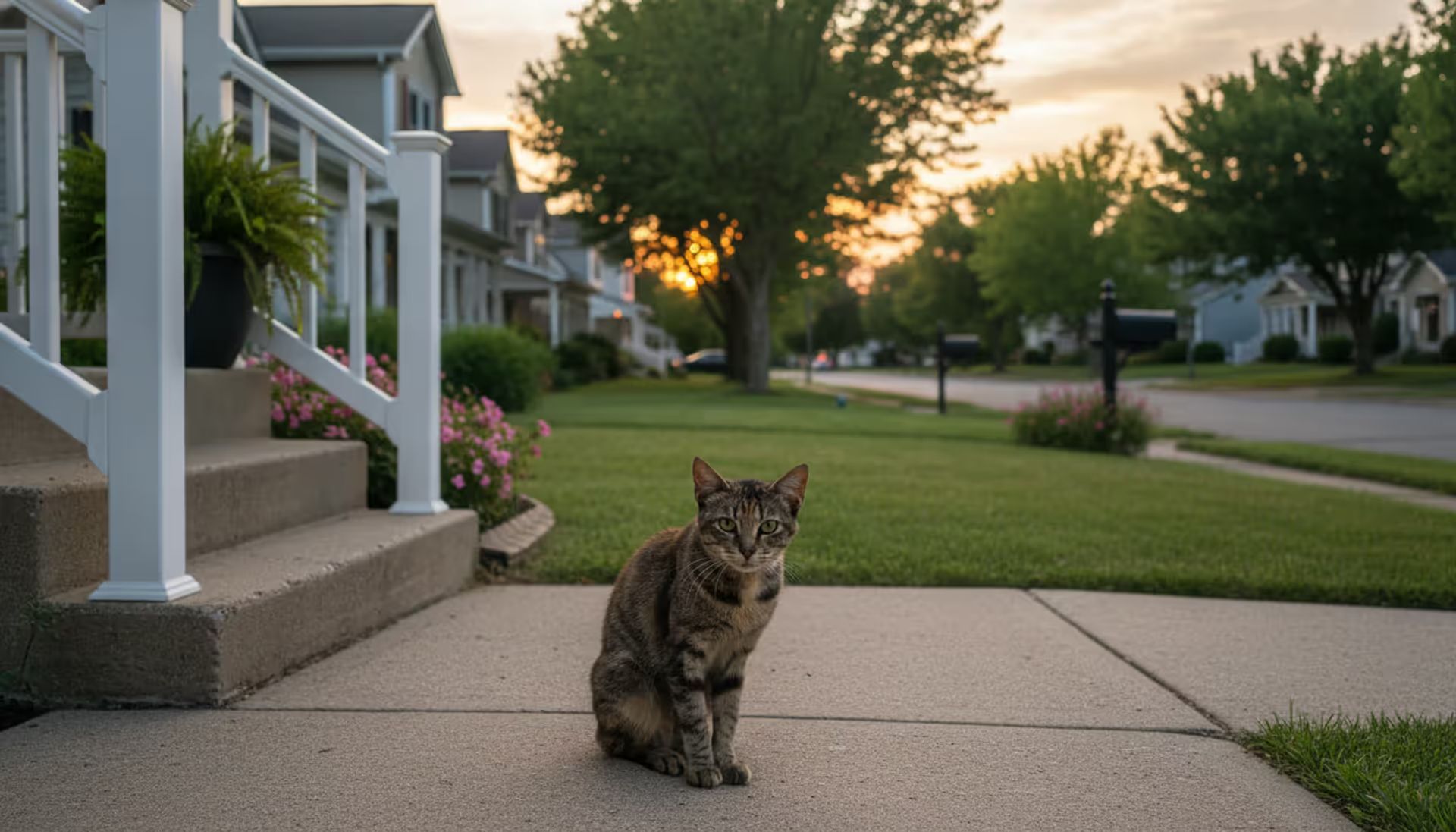
Here's something most property owners don't realize until it's too late: that feral cat lounging on your porch exists in a legal twilight zone. It's not wildlife. It's not technically a pet. And depending on which side of the county line you're on, your options for dealing with it could range from "call animal control and they'll handle it" to “you're now personally liable if you touch it.”
I've seen neighbors end up in small claims court over this. One thought she was helping by trapping and relocating cats from a residential area. The other had been running a registered colony management program for three years. The result? $2,400 in damages plus legal fees, all because nobody checked what the actual municipal code said.
The rules governing feral cats have been rewritten street by street over the last fifteen years. Your city might fund trap-neuter-return initiatives while the next town over still operates on catch-and-euthanize. Property rights, animal cruelty statutes, and public health regulations all crash into each other here, creating a mess that's different in every jurisdiction.
Understanding Feral Cats vs. Stray Cats Under the Law
This distinction isn't just semantics—it determines whether you're dealing with someone's lost property or an unowned animal. Courts actually care about this.
A stray cat? That's an animal that lived indoors, knows humans, and got separated from an owner. Maybe it slipped out during a move. Maybe someone dumped it. Either way, it's socialized. It'll approach people. Put it in a carrier and it won't rip your hand off. Legally, these animals still count as property, even without a collar.
Feral cats have never been house pets. Born outside, raised by an unsocialized mother, these animals view humans as predators. You're not adopting a feral cat—it would live under your bed and pee on your furniture for the rest of its life. Most animal behaviorists draw the line at 8 weeks. Kittens socialized before that can become pets. After that window? You've got a feral animal.
Author: Samantha Loring;
Source: jamboloudobermans.com
Why does this matter for removal? Because taking someone's lost property—even a cat you found wandering your yard—can get you charged with theft in some states. Virginia courts ruled in 2019 that a cat receiving regular food from anyone (even inconsistently) might still have an owner. That case involved a guy who trapped what he thought was a feral cat, only to discover it belonged to a neighbor who let it roam. He ended up paying $800 in restitution.
Some states call feral cats wildlife. Others label them abandoned property. California and about a dozen other states now use "community cat" in their legal code, which creates a whole separate category with different rules. Texas counties can't even agree—in Travis County, they're managed through public health ordinances, but in Harris County, they fall under the livestock commissioner's authority (yes, really).
Here's where property rights get complicated. You can exclude animals from your land. That's basic property law. But your exclusion method can't violate anti-cruelty statutes, which every state has. So while you've got the right to trap a feral cat on your property, you don't have the right to drown it, poison it, or dump it twenty miles away in someone else's neighborhood—all things people have tried and been prosecuted for.
Legal Methods for Feral Cat Removal in Your Area
What you can legally do about feral cats depends almost entirely on your ZIP code. And I mean that literally—Phoenix operates differently than Scottsdale, despite being in the same metro area.
Most places let property owners trap feral cats. The trapping itself usually isn't the problem. It's everything that comes after. Phoenix requires you to call animal control within 24 hours of trapping. The cat gets scanned for a microchip, held for five days (in case someone claims it), then either goes into a registered TNR colony or gets euthanized if shelter space doesn't exist. You can't just decide to drive it out to the desert and release it. That's illegal dumping of animals, and the fine runs $1,000 in Arizona.
California actually prosecutes the relocation thing. A Los Angeles woman got convicted in 2024 for trapping neighborhood cats and releasing them in the Angeles National Forest. She thought she was being humane. The court disagreed—abandoned domestic animals create ecological problems and usually die slowly from starvation or predation. She paid $5,000 in fines and got six months probation.
Professional removal services need licenses in most states, though the specific agency issuing those licenses varies wildly. In Florida, you need a wildlife control permit from the Fish and Wildlife Conservation Commission. In New York, it's the Department of Environmental Conservation. Illinois requires pest control licensing through the Department of Public Health. Hiring someone without proper credentials transfers liability to you as the property owner if something goes wrong.
I've seen people make expensive mistakes with trap types. Leg-hold traps are banned for cats in all 50 states under anti-cruelty laws. Live cage traps are the only legal option, and even those must be checked every 24 hours in most jurisdictions. Leave a trap unattended for three days in summer heat? That's animal cruelty, even if you forgot about it. A Tennessee homeowner learned this lesson with a $2,500 fine in 2023.
Author: Samantha Loring;
Source: jamboloudobermans.com
Here's something that catches people off guard: transporting trapped cats across county lines often requires health certificates. Florida will charge you with illegal animal transportation if you drive a trapped feral cat from Broward County to Miami-Dade without the proper paperwork. Even if you're taking it to a shelter. Even if your intentions are good.
Municipal policies vary dramatically on nuisance complaints. File a complaint about feral cats in Austin, Texas, and you'll get information about their TNR program—they won't remove healthy cats. The same complaint in rural Texas counties might get animal control out within 24 hours to trap and euthanize. Before you do anything, call your local animal control and ask for their feral cat policy in writing. Not a verbal answer—written policy. Enforcement priorities change, administrations change, and "they told me it was fine" won't help when you're facing charges.
Trap-Neuter-Return Programs and Legal Status
TNR went from fringe idea to mainstream policy faster than almost any animal welfare concept in US history. Twenty years ago, it barely existed. Now more than 600 cities have formal programs.
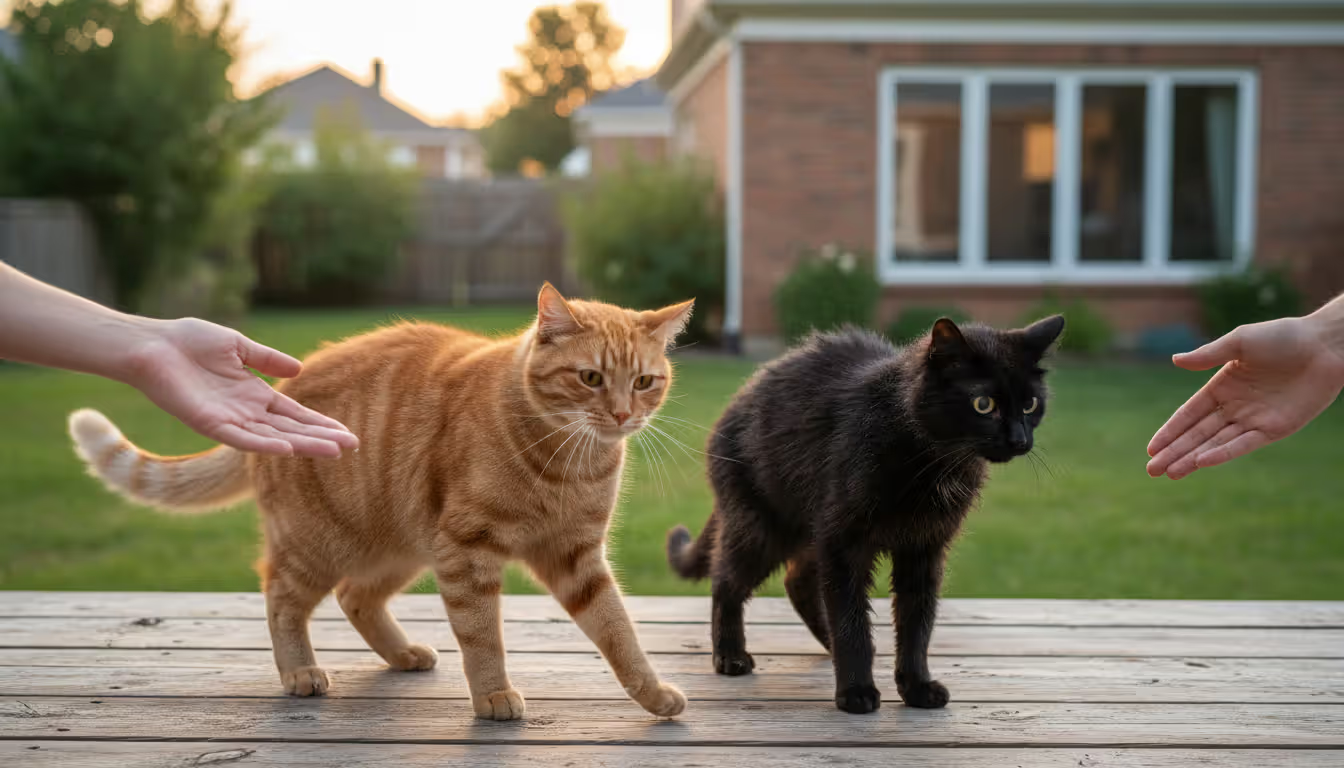
The concept is straightforward enough: Trap feral cats humanely. Get them sterilized by a vet. Vaccinate them for rabies. Clip the tip of one ear (that's how you identify a "fixed" cat from a distance). Return them to where you found them. The theory says you're preventing more kittens while letting the current population age out naturally.
Delaware passed the nation's most comprehensive Community Cat Act in 2018. It's 14 pages of detailed framework covering everything from liability protection to funding mechanisms for spay/neuter programs. The law prevents any Delaware city from banning TNR and creates explicit legal protection for people who return sterilized cats—which would otherwise count as animal abandonment under state law. Without that protection, TNR participants were theoretically criminals every time they released a cat.
Utah took a different approach, focusing specifically on HOA restrictions. Their 2023 legislation says homeowners associations can't prohibit TNR activities or penalize residents who participate in registered programs. This came after multiple cases where HOA covenants forbidding "feeding wildlife or stray animals" were used to threaten TNR volunteers with fines. One Salt Lake City woman faced $100 daily fines from her HOA until the state law shut that down.
But TNR isn't universally accepted. Texas has zero state-level policy on it. That means Dallas operates a city-funded TNR program with registered colonies and official caretaker protections, while you drive 30 miles east into Kaufman County and TNR isn't even recognized. You're just someone illegally feeding animals.
Miami-Dade County banned returning trapped cats to public property in 2015, effectively killing TNR in public spaces. The ordinance got amended two years later after massive pushback, now allowing returns on private property with written owner consent. But you can't maintain a colony in a public park, on a school campus, or on county-owned land. Period.
Registration requirements are the price of legal protection. Los Angeles makes you register through FixNation (a nonprofit that partners with the city). You're limited to 15 cats per colony location. You need proof that all cats are sterilized and vaccinated. You need written permission from property owners if the colony isn't on public land. Miss any of those requirements and you lose your immunity from nuisance prosecution.
New York's legislation includes a particularly important protection: Providing food and water to community cats does not establish ownership or create custodial responsibility. That matters because if feeding cats made you their legal owner, you'd be liable for every chicken they kill, every car they scratch, every garden they dig up. With that statutory protection, you can participate in TNR without becoming legally responsible for everything those cats do.
Feral Cat Caretaker and Colony Manager Legal Rights
Being a feral cat caretaker used to be legally invisible—you were just someone feeding strays. Now it's an actual recognized role in many places, with formal responsibilities and genuine protections. But those protections evaporate fast if you don't follow the rules.
Registered caretakers in most programs have specific duties. California's guidelines (which vary by county) typically require weekly feeding schedules, immediate cleanup of food debris, quarterly population counts submitted to animal services, and prompt response to neighbor complaints. You're maintaining vaccination records. You're trapping and altering any new cats that show up within 30 days. You're managing the colony, not just feeding it.
San Diego County requires caretakers to keep a binder with photos of each cat, vaccination dates, sterilization dates, and vet records. During inspection (yes, they can inspect), you need to produce that documentation. One caretaker lost her registered status in 2022 when she couldn't prove that three cats in her colony were vaccinated. Those cats got trapped and removed, and she couldn't do anything about it.
Author: Samantha Loring;
Source: jamboloudobermans.com
Liability protection is why people register in the first place. In jurisdictions with formal programs, you generally can't be prosecuted for animal abandonment or cited under feeding bans. That's huge. But a Portland, Oregon caretaker learned the limits of that protection when her registered colony—supposed to be capped at 25 cats—grew to 38. Neighbors complained, animal control investigated, found she'd violated program limits, and revoked her status. When cats from the colony damaged a neighbor's vegetable garden, she got sued and lost because she no longer had statutory immunity.
Property owner rights trump caretaker interests almost everywhere. You're maintaining a colony on private land? You need written permission from the owner, renewed annually in most programs. If that permission gets revoked, you've got 30 days (sometimes less) to trap and relocate the entire colony. And relocation isn't easy—most places require you to confine relocated cats for 2-4 weeks so they don't try to return to their original territory.
Public land gets even messier. Some cities allow registered colonies in parks with official permits. Others ban it completely. Chicago's program lets you maintain colonies on Chicago Parks District property if you've got a permit and follow specific rules about feeding stations (must be concealed, must be cleaned daily, can't be visible to park visitors). But try that in a neighboring suburb without checking their policy first and you're likely getting your traps confiscated and facing citations.
Cook County, Illinois requires caretakers to complete an eight-hour training program, obtain liability insurance ($300,000 minimum coverage), and pay $150 for annual permit renewal. That's not cheap. But it gives you legal standing. Courts have repeatedly held that unregistered people feeding feral cats can be held liable for nuisance conditions—property damage, noise, sanitation problems. Registered caretakers following program guidelines get statutory protection from those claims (within limits).
Euthanasia Laws and When Removal Is Permitted
Every state allows euthanasia of feral cats under certain circumstances. None prohibit it entirely. But the rules about when, how, and who can do it are strict enough that people regularly break them without realizing.
Legal grounds for euthanasia typically require documentation. Public health threats—like confirmed rabies exposure or an outbreak situation—give animal control broad authority. Injuries or illness making a cat unsuitable for TNR (FIV-positive cats can often still be returned, but severe injuries or contagious diseases like feline leukemia usually trigger euthanasia). And the most common reason: No available shelter space after the mandatory holding period expires.
That holding period varies. Colorado requires five business days. California requires six. Mississippi says four. These aren't suggestions—they're statutory minimums designed to give owners time to claim lost pets. Euthanize before the holding period expires and you're violating state law, even if the shelter is overcrowded.
More jurisdictions now require veterinary assessment before healthy cats get euthanized just for space. Los Angeles Animal Services adopted this policy in 2020. If a vet examines a cat and finds it healthy, sterilized, and vaccinated, it should go to a registered TNR colony rather than get euthanized. The policy isn't legally binding (the city can override it in emergencies), but it creates a presumption that's hard to rebut without documenting why TNR wasn't viable.
Prohibited methods are spelled out in state anti-cruelty laws. You cannot drown cats. You cannot poison them. You cannot shoot them (with narrow exceptions for licensed animal control in rural areas following AVMA guidelines). You cannot use decompression chambers. South Carolina still allowed gunshot for feral cats until 2021, when the law changed after video of animal control shooting cats in a parking lot went viral.
Acceptable methods are limited to IV or intracardiac injection of sodium pentobarbital or equivalent euthanasia solution. That's it. And only specific people can administer it: licensed veterinarians, certified animal control officers, or registered euthanasia technicians working under veterinary supervision.
A rancher in West Texas learned this the hard way in 2025. He'd been shooting feral cats on his property for years, considering them vermin like coyotes. Someone reported it. Texas Parks and Wildlife investigated and charged him with animal cruelty—multiple counts. His defense was that they were on his land, harming his chickens, and he could protect his property. The court said state anti-cruelty law doesn't contain a property-protection exception for cats. You can't just shoot them. He paid $8,000 in fines and got probation.
Documentation requirements function as a check on abuse. Shelters and animal control agencies log every euthanasia: date, time, method, specific reason, personnel involved. Many states require monthly reports to the state veterinary board. Public disclosure laws often make these records available on request, which is how activists identify shelters with high euthanasia rates and push for policy changes.
State-by-State Feral Cat Law Overview
Author: Samantha Loring;
Source: jamboloudobermans.com
State law on feral cats ranges from comprehensive regulation to complete silence. Some states have detailed statutes covering everything from TNR authorization to caretaker liability. Others don't mention feral cats at all, leaving everything to county and city ordinances.
Delaware's Community Cat Act is probably the most thorough state-level legislation. Passed in 2018, it runs 14 pages and addresses definitions (what counts as a community cat), TNR procedures, caretaker registration, funding for spay/neuter programs, and liability protections. It explicitly prevents Delaware cities from banning TNR—local governments can regulate the programs but can't prohibit them. Any shelter receiving public funding must offer TNR as an alternative to euthanasia for healthy feral cats.
Utah's approach focuses narrower. Their 2023 law targets HOA restrictions, preventing homeowners associations from prohibiting TNR or penalizing residents who participate. It doesn't create a statewide TNR framework or address euthanasia procedures. But it removes a major obstacle that TNR volunteers faced in managed communities.
Rhode Island's statute provides legal immunity from animal abandonment charges for TNR participants. Before that law passed in 2020, there was theoretical legal risk—returning a trapped cat to the street could constitute "releasing an animal," which violated the state's abandonment prohibition. The new law says returning a sterilized, vaccinated, ear-tipped cat as part of a registered TNR program isn't abandonment.
On the other end, Wyoming has no state law mentioning feral cats specifically. Neither does Montana. The Dakotas don't have state-level regulation. In these states, feral cats get managed under general animal control statutes or even livestock laws in some rural counties. This usually means fewer protections and less standardized procedures. What happens depends entirely on what your local animal control decides to do.
Most states fall in the middle with patchwork local laws creating different rules every few miles. Texas is the poster child for this. Austin's TNR program gets city funding, maintains registered colonies, provides caretaker protections, and prioritizes returning healthy cats over euthanasia. Drive 30 minutes east into Bastrop County and feral cats are handled by whoever answers the animal control phone that day, with no formal policy, no TNR option, and euthanasia as the default.
State
TNR Legal Status
Euthanasia Permission
Caretaker Liability Protection
Colony Registration Required
California
Authorized locally (most major cities have programs)
Allowed after 6-day hold; restricted for healthy cats in some counties
Limited, varies by county; some programs provide immunity
Yes, in cities with formal TNR programs
Delaware
Statewide authorization through Community Cat Act
Restricted for healthy cats; TNR must be offered first
Yes, statutory immunity for registered caretakers
Yes, statewide registration system
Florida
County-by-county; Miami-Dade restricts it heavily
Generally permitted after 5-day hold
No statewide protection; some counties provide limited immunity
Varies by county and city
Illinois
Authorized in Chicago, Cook County, and other major cities
Permitted after 5-day hold
Yes, in registered programs (requires training and insurance)
Yes, in participating jurisdictions
New York
Widely authorized; NYC has comprehensive program
Restricted in NYC for healthy cats; other areas vary
Yes, statutory protection from ownership liability
Yes, in cities with TNR programs
Texas
Local option; Austin, Dallas, Houston have programs; rural counties don't
Generally permitted after 3-day hold
No statewide protection
Varies completely by municipality
Utah
Statewide authorization; HOAs cannot prohibit
Permitted after holding period
Yes, protection from HOA restrictions
Recommended but not always required
Virginia
Varies by locality; some counties have programs, others don't
Generally permitted after 5-day hold
Limited; depends on local ordinances
Varies by locality
Researching your local law requires checking multiple sources, and the official code isn't always enough. Start with your city's municipal code—most cities have it online now, searchable by keyword. Look for "feral cat," "community cat," "TNR," or "trap-neuter-return." But also search for general "animal control" sections that might address it indirectly.
County ordinances apply if you're outside city limits. These are sometimes harder to find online, especially in rural counties. You might need to call the county clerk's office and ask for animal control ordinances.
State statutes provide the baseline, but they're often general. Check your state's agriculture or health department website—feral cat law sometimes lives in unexpected places (like public health codes rather than animal welfare statutes).
And here's the important part: Call your local animal control and ask for their written policy on feral cats. Not what they tell you verbally. Written policy. Enforcement practices change with new directors, budget constraints, or political pressure. Get it in writing so you know what they're actually doing, not just what the 15-year-old ordinance says.
Local TNR organizations are goldmines for practical information. They know what's officially on the books versus what animal control actually enforces. They know which judges are sympathetic and which will throw the book at you. That street-level knowledge matters more than being able to recite the municipal code.
What we're seeing is a fundamental shift in how the law conceptualizes feral cats.Fifteen years ago, legal frameworks treated feral cats as nuisance animals—essentially vermin—subject to removal and destruction at will. Now we're watching jurisdictions adopt management models that recognize these animals as part of the urban ecosystem. But here's what creates problems for everyone: The change is happening at wildly different speeds depending on where you are. You can cross a county line and go from a jurisdiction with registered caretaker protections and funded TNR programs to one where feeding feral cats might get you cited for maintaining a public nuisance. Anyone dealing with this issue—property owners, caretakers, concerned neighbors—needs to understand that there's no uniform national standard. You absolutely have to know the specific rules in your locality, not just general principles
— Rebecca Hale
Frequently Asked Questions About Feral Cat Removal Laws
Is it illegal to trap and remove feral cats from my property?
Trapping them? Usually legal on your own land. What happens next is where you can get in trouble. You can't euthanize cats yourself, release them somewhere else, or harm them. Most places require you to contact animal control within 24 hours of trapping—that's not a suggestion, it's legally mandated in many jurisdictions. Some cities with TNR programs will push you to work with registered colony managers instead of removing cats completely. Before you set a trap, look up your municipal code. A handful of cities require permits even for property owners trapping on their own land.
What's the difference between a feral cat and a stray cat legally?
Stray cats are lost or abandoned property—someone might own them. Feral cats are unowned animals that have never been socialized to humans. That distinction changes everything: how long shelters must hold them (strays get longer holding periods for owner claims), whether they can be adopted (strays yes, ferals rarely), and your legal risk for removing them. Courts consider whether the cat approaches humans, seems comfortable around people, or wears any identification. A Texas court ruled in 2018 that a cat accepting food from multiple neighbors still had an owner—the guy who trapped and relocated it got hit with theft charges. If there's any doubt whether it's feral or stray, assume stray and follow stricter protocols.
Can I be sued for feeding feral cats on my property?
Absolutely. Neighbors have successfully sued for nuisance when cats attracted by feeding damage property, create unsanitary conditions, or cause ongoing disturbances. Some courts say regular feeding creates a duty of care, making you responsible for what those cats do. A California woman lost a $4,200 judgment in 2023 after cats she fed destroyed a neighbor's koi pond. But if you're registered as a caretaker in a formal TNR program, many jurisdictions provide liability shields. The catch is you've got to follow all program requirements—feeding without sterilizing and properly managing the colony won't protect you from lawsuits.
Are TNR programs legally recognized in all states?
Not even close. Delaware and Utah have statewide laws authorizing TNR. Other states leave it entirely up to cities and counties. A few places explicitly ban returning cats after trapping (parts of Florida, for example). Even where TNR is authorized, it's usually heavily regulated—you need registration, vaccination records, and written permission from property owners if the colony isn't on public land. Before you start TNR activities, verify your city or county specifically allows it. Don't assume. A woman in rural Georgia spent $3,000 on legal fees in 2024 defending against animal abandonment charges because her county had no TNR recognition and treated her returned cats as illegal release of animals.
What should I do if my neighbor is managing a feral cat colony?
First step: Find out if it's registered. Registered colonies have legal protection in most places, so you'll need to work within that system. Document specific problems with dates, photos, and details—property damage, noise at specific times, health concerns. File a formal complaint with animal control. They can check whether the caretaker is following program requirements (colony size limits, vaccination records, feeding schedules). If the colony is unregistered, you've got stronger grounds for action, but you still can't trap cats yourself without following local procedures. Many disputes get resolved by requiring the caretaker to move feeding stations away from property lines or reduce colony size rather than complete removal.
Can animal control remove feral cats from private property?
Animal control needs either property owner permission or specific legal authority (like a court order or public health emergency). If you own the property and request removal, they'll respond based on local policy. Cities with TNR programs might offer sterilization and return instead of removal. Traditional jurisdictions may trap and euthanize. On public property, animal control has broader authority, though many agencies now default to TNR over removal. If feral cats create a documented health hazard—active rabies outbreak, for instance—animal control has emergency powers to remove them even from private property without owner consent, though this is rare and requires significant documentation.
Getting feral cat removal right means understanding three layers of law: state statutes (which might not even mention feral cats), county ordinances (which often fill in gaps the state left), and city policies (which can be surprisingly detailed and restrictive). What you can legally do in Austin doesn't apply in Houston, despite both being in Texas. Cross from Los Angeles County into Orange County and the rules change.
Property owners have rights to exclude animals from their land, but those rights operate within animal welfare laws that prohibit cruelty and sometimes require specific procedures. Caretakers running TNR programs have legal standing in many places now, but only if they register, follow program requirements, and maintain documentation. Neighbors dealing with nuisance situations have recourse through animal control and nuisance laws, but the effectiveness of complaints depends heavily on local policy priorities.
The single biggest mistake people make is assuming the law works the way it "should" work logically, rather than checking what it actually says. Your city might have a three-page ordinance on feral cats that nobody's ever read. Or it might have no law at all, leaving everything to animal control discretion. You won't know until you look it up.
Start with your municipal code. Call animal control and get their policy in writing. If you're dealing with a complex situation—like a neighbor threatening to sue over your TNR colony, or a property dispute involving colony location—talk to a local attorney familiar with animal law before the situation escalates. Prevention is cheaper than defense.
The trend is toward managed colonies and TNR rather than traditional trap-and-euthanize, but that trend is moving at different speeds across the country. Some places are ahead of the curve. Others are stuck in policies from 1985. Knowing where your jurisdiction falls on that spectrum is the only way to make informed decisions about feral cat removal that won't land you in legal trouble.
The commercial dog breeding industry produces millions of puppies annually in conditions most pet owners never see. Understanding the welfare problems, health consequences, and ethical issues behind puppy production helps consumers make informed decisions that reduce animal suffering and save lives
The dog meat trade involves breeding, transporting, and slaughtering millions of dogs annually for human consumption, primarily in Asia. Despite growing bans worldwide, enforcement challenges persist. Learn about US laws, international legal status, cruelty concerns, and advocacy efforts
Dog abuse encompasses deliberate physical harm, severe neglect, and psychological torment under federal and state laws. Learn to recognize physical and behavioral signs, document evidence properly, and report through correct legal channels. Penalties range from misdemeanors to felonies with up to 10 years imprisonment
Some dog breeds suffer from genetic conditions so severe that experts question whether continuing their bloodlines constitutes cruelty. Understanding unethical breeding practices means examining breathing problems, shortened lifespans, and the legal frameworks designed to protect animals from profit-driven operations
The content on this website is provided for general informational and educational purposes only. It is intended to explain concepts related to animal law, pet ownership rights, service animals, dog bite liability, and animal welfare legislation in the United States.
All information on this website, including articles, guides, and examples, is presented for general educational purposes. Legal outcomes may vary depending on jurisdiction, state laws, and individual circumstances.
This website does not provide legal advice, and the information presented should not be used as a substitute for consultation with qualified attorneys or animal law professionals.
The website and its authors are not responsible for any errors or omissions, or for any outcomes resulting from decisions made based on the information provided on this website.