When couples separate, deciding who keeps the dog can become one of the most emotionally charged battles. Unlike dividing furniture or bank accounts, pets hold irreplaceable emotional value. Yet the legal system still struggles with how to handle these disputes. Understanding dog custody laws helps you protect your rights and prepare for what courts actually consider when determining ownership.
How Courts Treat Dogs in Divorce Cases
Most American courts still apply the traditional pet-as-property doctrine. Under this framework, dogs are classified as personal property, similar to vehicles or electronics. The court assigns ownership to one party rather than creating ongoing custody arrangements. This approach focuses on who legally owns the animal, not who has the strongest emotional bond.
However, a handful of states have begun recognizing that pets occupy a unique category. Alaska, Illinois, and California now allow judges to consider the well-being of the animal when making custody determinations. Alaska's statute, enacted in 2017, specifically permits courts to assign joint custody and consider factors like who provided care and financial support. Illinois followed in 2018 with similar provisions allowing judges to allocate "sole or joint ownership" based on the animal's best interests.
California's law goes further by requiring courts to consider who cared for the pet during the marriage. These states represent a small but growing trend toward treating companion animals differently from inanimate property. The shift reflects changing attitudes about the human-animal bond, though it remains far from universal.
Most states—including Texas, Florida, New York, and Georgia—maintain the strict property classification. In these jurisdictions, judges cannot consider emotional attachment or caregiving history unless both parties agree to it. The court simply determines legal ownership and awards the dog accordingly. This creates frustration for parties who invested years in caring for a pet but lack documentation proving ownership.
Even in progressive states, courts rarely order ongoing shared custody arrangements. Judges prefer clean breaks that avoid future conflict. The "best interest" analysis typically results in sole ownership to one party, with the other receiving visitation rights only if both agree.
Author: Samantha Loring;
Source: jamboloudobermans.com
How Courts Decide Who Gets the Dog
When ownership is disputed, judges examine specific evidence to determine who owns a dog in divorce legally. The analysis resembles resolving any property dispute: who purchased it, who paid for it, and whose name appears on official documents.
Purchase documentation carries significant weight. If you bought the dog before marriage and have receipts showing your name, courts generally award ownership to you as separate property. Dogs acquired during marriage become marital property subject to division, making ownership less clear-cut.
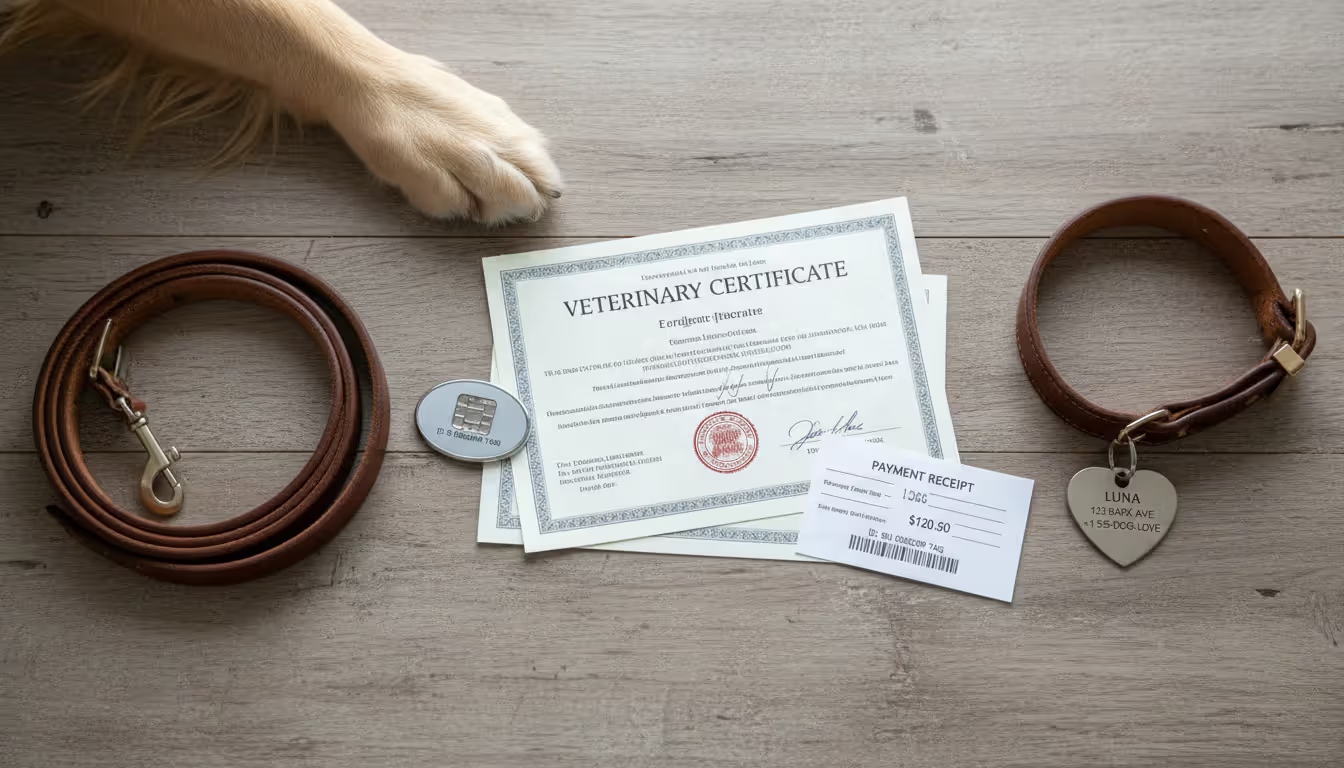
Registration and microchip records matter enormously. If the dog is licensed in your name with the city or county, that creates a strong presumption of ownership. Microchip registration databases showing your contact information provide powerful evidence, especially if registered before the dispute arose.
Veterinary records demonstrate both financial responsibility and caregiving. Courts examine who paid for routine care, vaccinations, surgeries, and medications. Consistent payment history in your name suggests ownership, though judges recognize that one spouse might handle finances while the other provides daily care.
Primary caretaker evidence includes who fed the dog, walked it, arranged vet appointments, and managed day-to-day needs. Text messages, emails, and social media posts can document caregiving patterns. Photos showing you with the dog over time help establish your relationship, though they carry less weight than financial records.
Adoption or breeder contracts listing your name as the adopter or purchaser provide strong evidence. If both names appear, courts look to other factors to break the tie.
Evidence That Proves Dog Ownership in Court
Proving dog ownership in court requires assembling documentation before you need it. The strongest evidence includes:
Financial records: Credit card statements, checks, or receipts showing you paid the adoption fee, purchase price, or rehoming fee. Ongoing expenses like food, toys, grooming, and boarding reservations in your name demonstrate continued ownership.
Veterinary documentation: Establish yourself as the client of record at your vet's office. Request copies of all records showing your name as the owner. Include vaccination certificates, surgical consent forms, and prescription records.
Registration documents: City or county dog licenses, AKC registration papers, microchip registration confirmations, and homeowner's insurance riders listing the dog. These official documents carry substantial weight.
Communication records: Emails with breeders, adoption agencies, or rescue organizations. Text messages discussing the dog's care, behavior, or health. Social media posts predating the dispute showing your involvement.
Witness testimony: Friends, family, neighbors, dog walkers, groomers, or trainers who can testify about who cared for the dog. Veterinary staff testimony about who brought the dog for appointments proves particularly persuasive.
Pre-relationship ownership: If you owned the dog before the relationship began, gather evidence of that timeline. Photos, vet records, and registration from before you met your ex establish separate property ownership.
Courts weigh documentation more heavily than testimony. Verbal claims about who loved the dog more or spent more time with it rarely succeed without corroborating evidence.
Author: Samantha Loring;
Source: jamboloudobermans.com
Dog Custody Agreements Outside of Court
Most pet custody disputes resolve through negotiation rather than litigation. Creating a dog custody agreement legally binding on both parties avoids court costs and allows customized arrangements that courts rarely order.
Mediation provides a structured environment where a neutral third party helps you reach agreement. Pet-focused mediators understand the emotional dynamics and can suggest creative solutions. Mediation typically costs $150-$400 per hour split between parties, far less than attorney fees for litigation.
A written pet custody agreement should specify:
Physical custody schedule: Which days each party has the dog, holiday rotations, vacation arrangements, and transportation responsibilities. Be specific about pickup times and locations to prevent future disputes.
Financial responsibilities: Who pays for food, routine vet care, emergency treatment, grooming, boarding, and pet insurance. Many agreements split costs proportionally or assign different categories to each party.
Decision-making authority: Who makes medical decisions, training choices, and lifestyle decisions like whether the dog can be around other pets or children.
Geographic restrictions: Whether either party can relocate with the dog and how distance affects the custody schedule.
Dispute resolution: How you'll handle disagreements, whether through mediation, arbitration, or another method.
Joint pet custody legal arrangements work best when both parties live near each other and maintain civil communication. Weekly or biweekly exchanges allow the dog to spend substantial time with both owners. Some couples alternate months or seasons, though longer separations can stress the animal.
Courts generally enforce written pet agreements as contracts, provided both parties signed voluntarily with full understanding. Including the agreement in your divorce decree or separation agreement strengthens enforcement. If one party violates the terms, the other can seek enforcement through contempt proceedings or breach of contract claims.
Practical considerations affect whether shared custody succeeds. Dogs thrive on routine, so frequent exchanges can cause stress. Older dogs or those with medical needs may struggle with changing environments. Assess your dog's temperament and adaptability honestly.
Author: Samantha Loring;
Source: jamboloudobermans.com
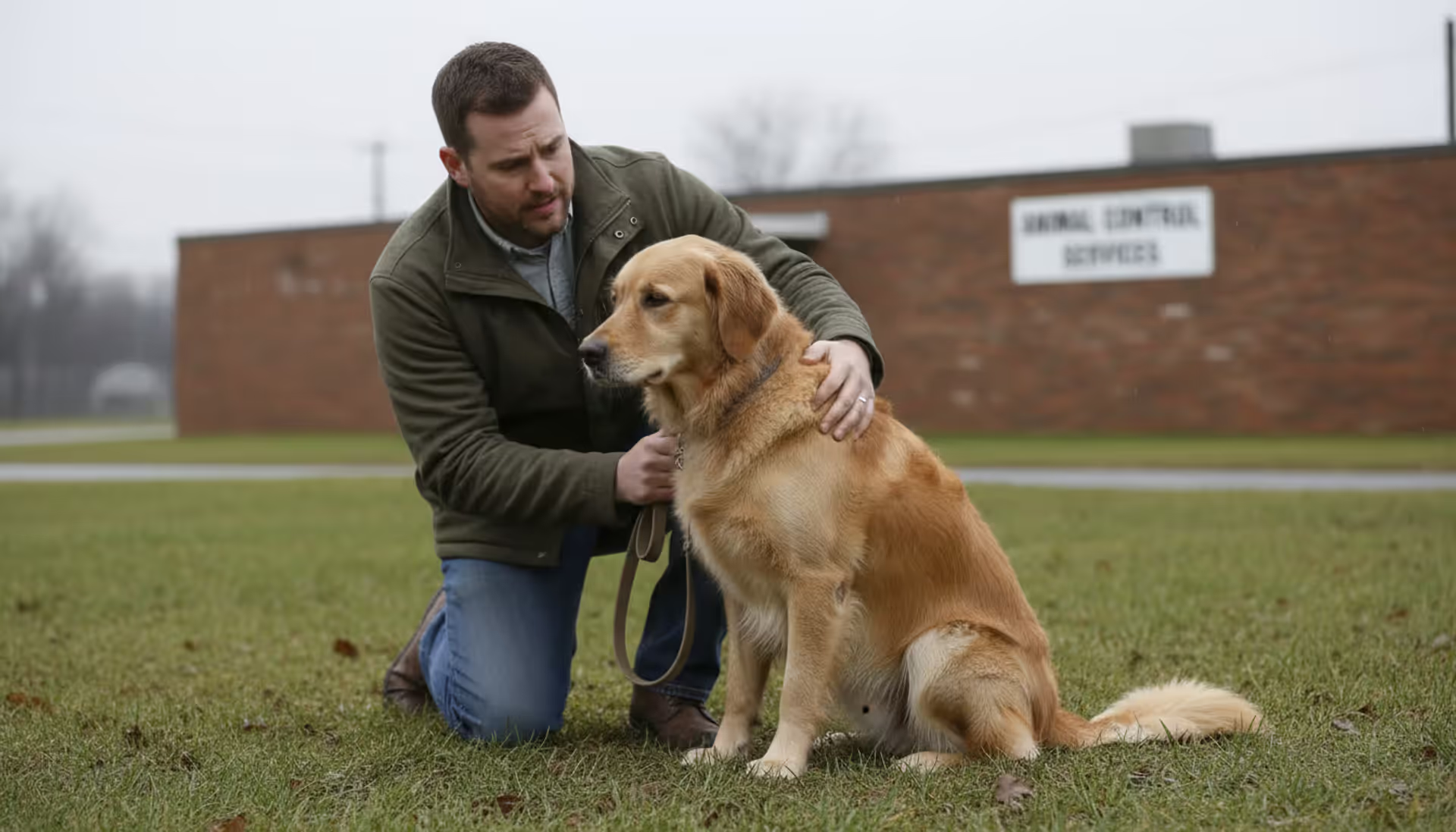
Taking a Dog Custody Dispute to Small Claims Court
When informal negotiation fails and the dog's value falls below your state's small claims limit, dog custody small claims court offers an accessible option. Small claims courts handle disputes involving property worth between $2,500 and $25,000, depending on state law.
Small claims suits work best when you seek ownership rather than ongoing custody arrangements. You're essentially asking the court to declare you the rightful owner and order the other party to return your property. Courts cannot order shared custody in small claims cases.
Filing requires completing a complaint form at your local courthouse, paying a filing fee ($30-$100 typically), and serving the defendant with notice. The process takes 30-90 days from filing to hearing in most jurisdictions.
Bring all evidence proving ownership: purchase receipts, vet records, registration documents, microchip information, photos, and witness statements. Organize documents chronologically and prepare a brief timeline of events. Small claims judges appreciate concise presentations focused on facts rather than emotions.
Most small claims courts prohibit attorneys, so you'll represent yourself. Practice explaining your case in 5-10 minutes, focusing on the strongest evidence. Anticipate what the other party will argue and prepare responses.
Typical outcomes include the judge awarding ownership to one party and ordering the other to return the dog within a specified timeframe. The court may award the value of the dog as damages if return proves impossible. Some judges offer both parties a chance to settle before ruling, which can result in negotiated solutions like one party buying out the other's interest.
Small claims judgments are enforceable through sheriff's deputies or contempt proceedings if the losing party refuses compliance. However, enforcement can prove difficult with a living animal that may be hidden or moved.
Real Dog Custody Case Examples
Actual animal custody rights case examples illustrate how courts apply these principles and what factors prove decisive.
Houseman v. Dare (2013, New York): A couple disputed ownership of a dachshund named Joey. The plaintiff presented evidence she purchased Joey before the relationship, paid all vet bills, and registered him in her name. The defendant argued he provided daily care and had a stronger bond. The court applied strict property analysis, awarding Joey to the plaintiff based on purchase documentation and registration. The judge explicitly rejected the defendant's emotional bond arguments, stating New York law treats pets as personal property without considering best interests.
Desanctis v. Pritchard (2002, Pennsylvania): After a seven-year relationship ended, both parties claimed ownership of two dogs. The court examined who paid adoption fees, whose name appeared on vet records, and who registered the dogs with the county. Evidence showed the plaintiff paid adoption fees and maintained vet records in her name, while the defendant's name appeared on county licenses. The court awarded one dog to each party based on the registration evidence, demonstrating how courts split ownership when documentation is mixed.
Travis v. Murray (2013, New York): This high-profile case involved a couple disputing custody of a miniature dachshund. The trial court initially applied property law, but the appellate court sent the case back for reconsideration of both parties' caregiving roles. While the court stopped short of adopting a best-interest standard, it acknowledged that some consideration of who provided care was appropriate. The case signaled growing judicial willingness to look beyond pure property analysis, though New York still hasn't formally adopted best-interest standards.
These cases teach important lessons. Documentation trumps emotional arguments in most jurisdictions. Registration and financial records prove more persuasive than testimony about daily care. Even in states moving toward best-interest analysis, courts prefer awarding sole ownership rather than ongoing shared arrangements.
Common Mistakes in Pet Custody Disputes
We're witnessing a fundamental shift in how courts conceptualize companion animals.The traditional property framework increasingly conflicts with how people actually relate to their pets. While most states haven't formally adopted best-interest standards, judges are finding creative ways to consider animal welfare within existing legal structures. The challenge is balancing judicial efficiency—courts want clean property divisions—with the reality that pets are sentient beings with needs and attachments. I expect we'll see more states following Alaska and Illinois in the next five to ten years, but the pace of change remains frustratingly slow for people in the middle of custody battles
— Dr. Rebecca Huss
Dog ownership dispute breakup cases often involve preventable errors that weaken your position.
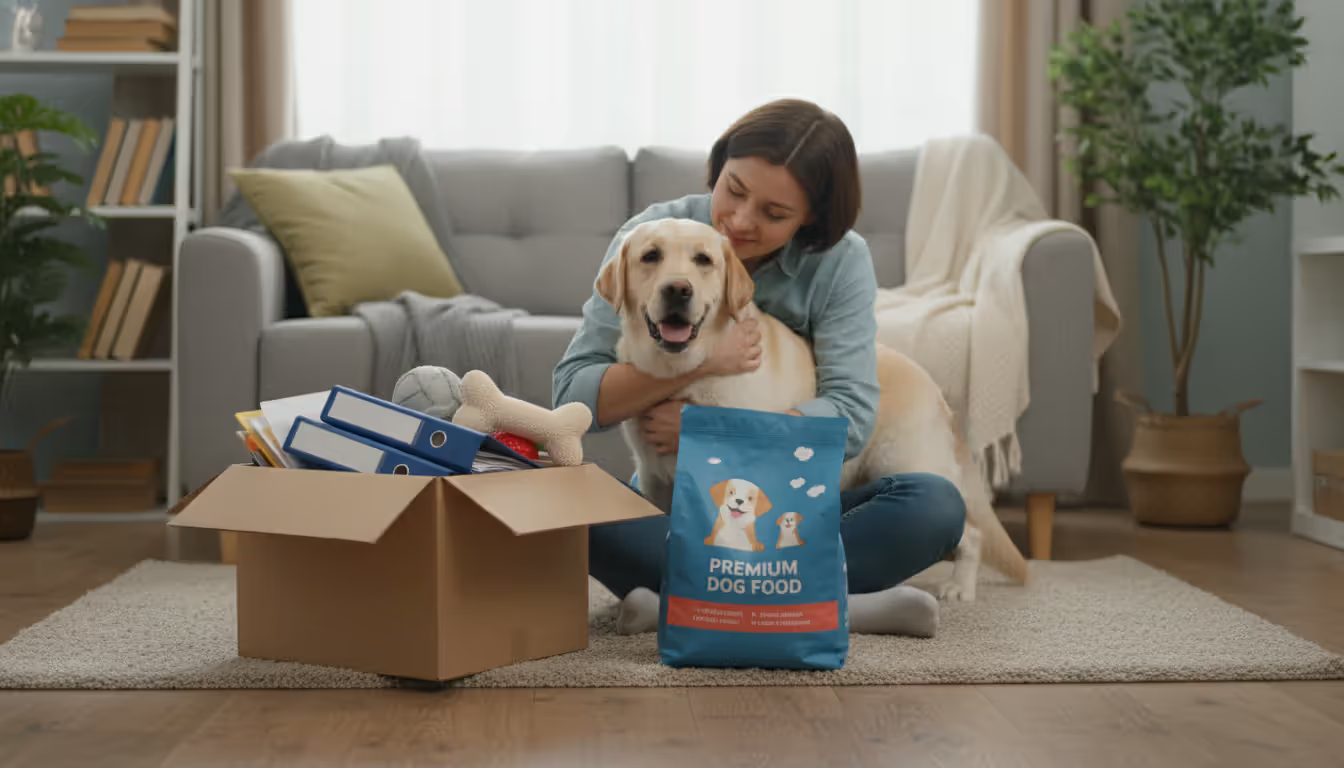
Failing to document ownership: Many people assume their relationship with the dog speaks for itself. Without receipts, registration, or vet records in your name, you lack proof. Start documenting ownership immediately when you acquire a pet, even in a committed relationship.
Relying on verbal agreements: Informal understandings about who owns the dog or how you'll share custody after separation rarely hold up. Put agreements in writing, with specific terms and both signatures. Verbal promises become he-said-she-said disputes.
Assuming equal rights: If your partner purchased the dog before you met, you likely have no legal ownership claim regardless of how much care you provided during the relationship. Similarly, if the dog was a gift to your partner, courts typically recognize the recipient as the owner.
Social media oversharing: Posting angry rants about your ex, threats about keeping the dog, or disparaging comments can be used against you in court. Photos showing the dog in poor conditions or admissions that you violated a temporary agreement damage your credibility. Assume anything you post will be printed and shown to a judge.
Rehoming without consent: Giving away or selling the dog while ownership is disputed can result in conversion claims (civil theft) and damage your position. Courts view unilateral rehoming extremely unfavorably, even if you believe you're the rightful owner.
Author: Samantha Loring;
Source: jamboloudobermans.com
Ignoring temporary orders: If a court issues temporary custody orders during divorce proceedings, violating them—even if you disagree—can result in contempt charges and harm your case for permanent custody.
Focusing solely on emotion: While your love for the dog matters to you, courts need legal evidence of ownership. Prepare to prove your case through documents and witnesses, not just testimony about your bond.
Failing to consider the dog's needs: Insisting on custody when your living situation, work schedule, or resources make proper care difficult can backfire. Courts in best-interest states will consider whether you can actually provide appropriate care.
State Approaches to Pet Custody
State
Legal Framework
Best Interest Consideration
Joint Custody Recognition
Notable Provisions
Alaska
Modified property
Yes, explicit statutory authority
Yes
AS 25.24.160(a)(4) allows courts to consider animal well-being; joint ownership permitted
California
Modified property
Yes, for community property pets
Limited
Fam. Code § 2605 requires consideration of care and safety of the pet
Illinois
Modified property
Yes, explicit statutory authority
Yes
750 ILCS 5/503(n) permits sole or joint ownership based on well-being
Texas
Traditional property
No
No
Pets treated as divisible marital property; no special provisions
Florida
Traditional property
No
No
Strict property analysis; ownership determined by title/purchase
New York
Traditional property with exceptions
Emerging in case law
No
Courts may consider care in limited circumstances (Travis v. Murray)
Washington
Traditional property
No
No
Community property state; pets divided as marital assets
Colorado
Traditional property
No
No
Standard property division rules apply to pets
Pennsylvania
Traditional property
No
No
Ownership based on purchase, registration, and documentation
Arizona
Traditional property
No
No
Community property state; pets assigned as property
This table reflects the legal landscape as of early 2026. Several states have pending legislation that may shift their approaches, and case law continues evolving even in traditional property states.
Frequently Asked Questions
Can I get joint custody of my dog after divorce?
Joint custody depends on your state and whether both parties agree. Alaska, Illinois, and California allow courts to order joint ownership arrangements based on the dog's best interests. In other states, courts cannot order shared custody, but you can create a voluntary agreement that functions as joint custody. These agreements work best when included in your divorce decree or formalized as contracts. Success requires both parties living relatively close to each other and maintaining civil communication for scheduling and decision-making.
What documents prove I own my dog legally?
The strongest proof includes purchase receipts or adoption contracts in your name, veterinary records listing you as the owner, city or county dog license registration, microchip registration documents, AKC or breed registry papers, and pet insurance policies. Financial records showing you paid for the dog's care—credit card statements for vet bills, food, or supplies—provide supporting evidence. If you owned the dog before your relationship began, gather documentation from that earlier period. The more official documents bearing your name, the stronger your ownership claim.
Is a pet custody agreement enforceable in court?
Yes, written pet custody agreements are generally enforceable as contracts between the parties. Courts treat them like other voluntary agreements, provided both parties signed with full understanding and without coercion. Including the agreement in your divorce decree or legal separation agreement strengthens enforceability. If one party violates the terms, you can seek enforcement through contempt proceedings (if part of a court order) or sue for breach of contract. However, courts rarely modify these agreements unless circumstances change dramatically or the agreement harms the animal.
How much does it cost to fight for dog custody?
Costs vary dramatically based on whether you litigate or negotiate. Small claims court costs $30-$100 to file plus minimal service fees, and you represent yourself. Mediation typically runs $150-$400 per hour, with most pet disputes resolving in 2-4 hours. Hiring an attorney for a contested custody battle during divorce can cost $2,000-$10,000 or more, depending on complexity and your location. If the dispute goes to trial, costs can exceed $15,000. Many people find the expense disproportionate to the dog's monetary value, making negotiated settlements more practical.
Can my ex take my dog without permission?
If you have clear legal ownership—supported by purchase records, registration, and vet documents—your ex taking the dog without permission could constitute theft or conversion. You can file a police report, though officers often treat pet disputes as civil matters requiring court resolution. If you have a custody agreement or court order, violation may result in contempt charges. Without clear ownership documentation, police and courts view the situation as a civil dispute between parties with equal claims. Obtain a court order establishing ownership or custody rights to prevent unauthorized taking.
Do courts consider who takes better care of the dog?
In Alaska, Illinois, and California, courts explicitly consider caregiving and the dog's well-being when determining custody. Judges examine who fed, walked, and provided medical care for the animal. In traditional property states, courts focus on legal ownership rather than quality of care. However, even property-focused courts may consider caregiving as evidence of ownership—the person who consistently paid for vet care and food likely has stronger ownership documentation. If you can prove the other party neglected or abused the dog, that may influence the outcome regardless of jurisdiction.
Dog custody disputes combine emotional intensity with complex legal questions. While most states still treat dogs as property, a growing number recognize that companion animals deserve special consideration. Your success in a custody dispute depends heavily on documentation—purchase records, vet bills, registration, and microchip information prove ownership far more effectively than emotional testimony.
Consider negotiating a custody agreement rather than litigating. Mediation costs less than court battles and allows creative solutions that judges rarely order. If you proceed to court, gather comprehensive evidence, organize it clearly, and focus on legal ownership factors rather than emotional bonds in property-focused states.
The legal landscape continues shifting. More states may adopt best-interest standards in coming years, reflecting society's evolving view of pets as family members rather than mere property. Until then, protect your rights by documenting ownership from the moment you acquire a dog, maintaining records in your name, and creating written agreements if you share a pet with a partner.
When your dog bites someone inside your home or on your property, you face potential legal liability, insurance complications, and serious consequences. Understanding homeowner liability laws, insurance coverage, and your responsibilities can mean the difference between a manageable situation and financial devastation
Police K9 attacks can cause severe injuries and lasting trauma. Understand when you can sue for excessive force, how government liability works, what compensation you may recover, and the critical steps to protect your rights after a police dog bite incident
When your dog attacks another dog, euthanasia is not automatic. The outcome depends on injury severity, bite history, state laws, and circumstances. Understanding the dangerous dog declaration process, your rights during hearings, and legal consequences helps you navigate this crisis effectively
A severe dog attack requires immediate medical attention and legal action. Learn critical steps to take after being mauled by a dog, including emergency care priorities, reporting procedures, documentation methods, victim legal rights, and available compensation for injuries and trauma
The content on this website is provided for general informational and educational purposes only. It is intended to explain concepts related to animal law, pet ownership rights, service animals, dog bite liability, and animal welfare legislation in the United States.
All information on this website, including articles, guides, and examples, is presented for general educational purposes. Legal outcomes may vary depending on jurisdiction, state laws, and individual circumstances.
This website does not provide legal advice, and the information presented should not be used as a substitute for consultation with qualified attorneys or animal law professionals.
The website and its authors are not responsible for any errors or omissions, or for any outcomes resulting from decisions made based on the information provided on this website.